Cost Reduction & Should-Cost Analysis
Many negotiations are conducted against a reference point that says little about cost. Comparing a supplier's offer with other offers, or with last year's price, gives useful market context; it does not show what the item should cost today, given what it is made of, where it is made and how the market for its inputs has moved.
We assess supplier pricing through cost driver analysis, should-cost modelling and the adjustment of historical prices for changes in relevant market inputs, so that every bid, price increase and renewal can be judged against evidence rather than expectation.
Our approach
Choose where cost analysis pays.
Should-cost analysis is most valuable where spend is high, competition is limited, the specification is stable or suppliers regularly ask for price increases. We prioritise categories on those criteria.
Decompose the price.
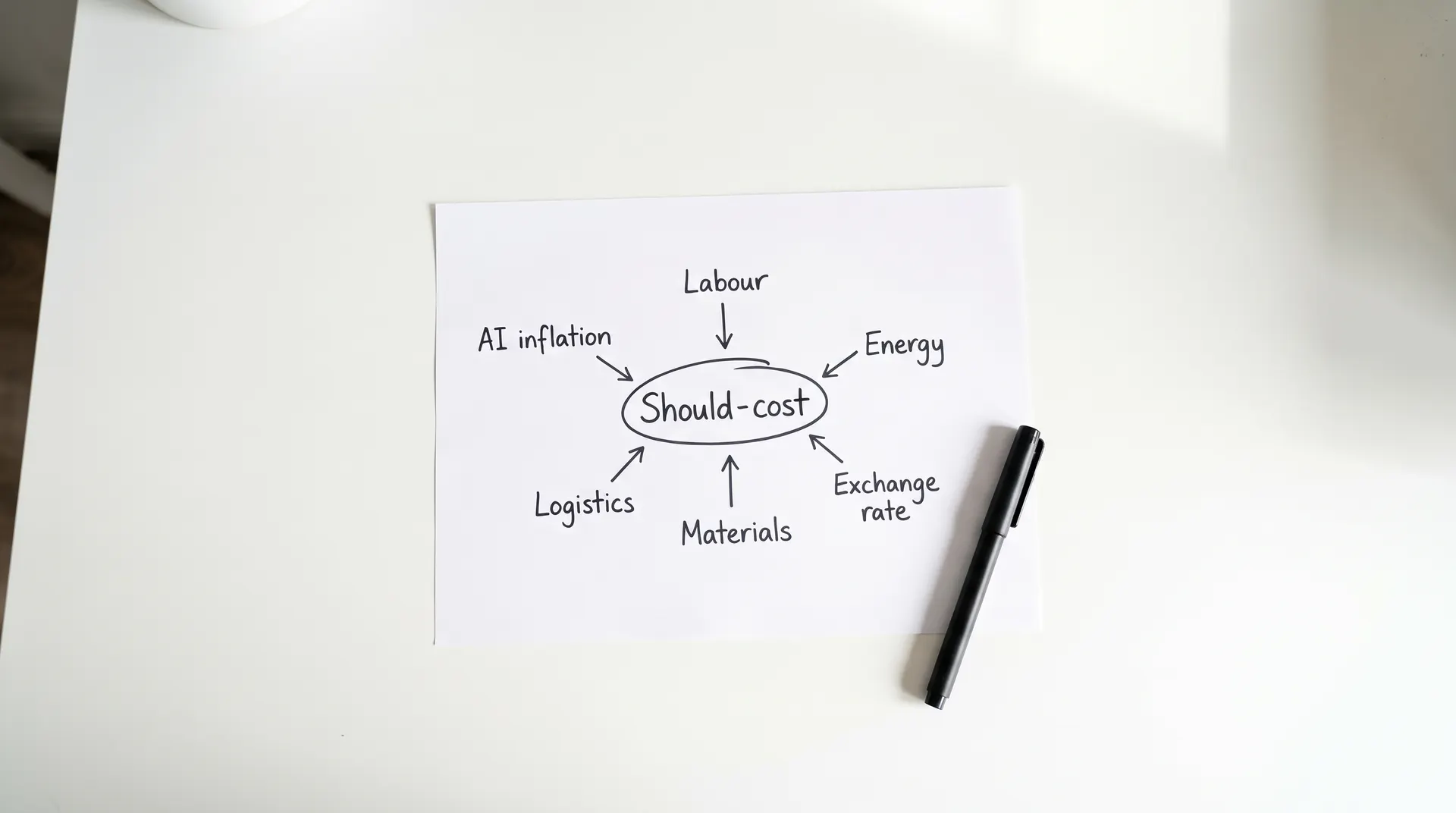
For each item we identify the cost drivers: materials, labour, energy, currency, logistics, overheads and margin, and how much of the price each one explains. The weighting differs by category; an imported IT product and a locally fabricated steel structure respond to very different forces.
Build the estimate.
Where an item can be modelled, we rebuild its cost from explicit assumptions on materials, process, quantities, labour and overheads: a should-cost model. Where it cannot, we take the last price paid and adjust it for changes in the relevant market inputs, recognising that this carries forward whatever margin and terms were in the original price. Either way, the result is an estimated cost range rather than a single number, and the width of the range reflects the quality of the data and the assumptions behind it.
AI-assisted analysis with professional review.
We are developing an AI-assisted method to assess changes in historical purchase prices using the relevant cost drivers. It makes the analysis faster and more consistent; every output remains subject to professional review.
Use it at the table.
The model becomes the reference for evaluating bids, testing price increase requests and preparing negotiations. When a supplier's price moves, the question becomes which cost driver moved, and by how much. Savings are reported against a stated baseline, such as a budget, an opening offer or the last price paid, so that results are not overstated.
Look beyond the price.
Where the price is fair but the cost is still too high, we look at total cost of ownership: specification, packaging, logistics, payment terms, stock levels and the cost of quality failures.
Key themes
Comparing quotes is price analysis. It provides market context and shows which supplier is cheapest among those who bid; it does not show whether any of them is reasonable. Cost analysis asks what the item should cost to produce and deliver. The two work together, and the distinction matters most when the field is thin, when suppliers price in the same way or when the market has moved faster than the contract.
A should-cost figure presented as a precise number invites a precise argument about the wrong thing. An honest estimate states its range and the assumptions behind it: complete, recent data supports a narrow range; generic descriptions or old reference prices widen it. Negotiating within a known range is stronger than defending a single figure that the supplier can pick apart.
In volatile markets, suppliers ask for increases citing inflation, currency or raw materials. A cost model turns the request into a structured discussion: which driver changed, by how much, and what share of the price it represents. Justified increases are accepted faster; unjustified ones are answered with evidence.
Cost drivers are not fixed. In technology categories through 2025 and 2026, demand from AI data centres has drawn memory and storage capacity towards AI hardware and pushed up the price of the components inside everyday servers, PCs and storage. A model that tracks only materials, labour and currency will misread these quotes. The drivers themselves have to be reviewed as markets change.
What we deliver
- Category prioritisation for cost analysis
- Cost driver breakdown and weighting per item or category
- Independent pre-tender estimates as cost ranges, with data and assumptions stated
- Bid evaluation against the estimate
- Price increase review framework
- Total cost of ownership analysis
- Negotiation briefing based on the cost model
Related case studies
Related services



Paying more than you should?
Tell us the category and what you pay today. We will tell you what we would expect it to cost.